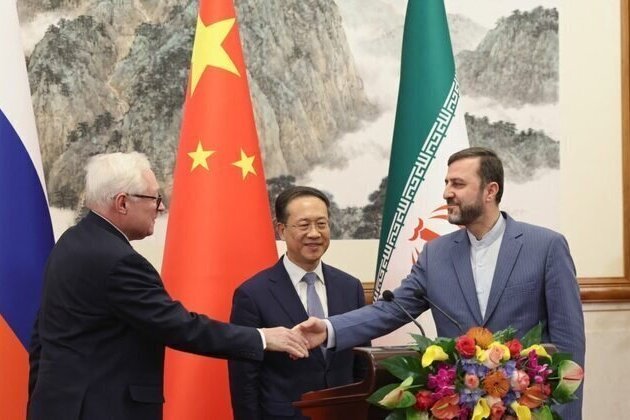
WASHINGTON-- Russia, China, and Iran are increasingly creating a strategic alliance of convenience that US policymakers must confront as it seeks to disrupt global order, according to a group of US experts and former officials.
Speaking on June 10 at the "America's Adversaries: The Russia Reality" national security briefing organized by the Independent Women's Forum, many of the panelists noted the transactional benefits are already yielding critical strategic dividends, particularly for an otherwise isolated Iranian regime.
Driven by their shared opposition to US dominance, the three countries are coordinating diplomatically, integrating their militaries and working on ways to evade Western sanctions.
"The question is whether there is a strategy of disruption, tactical convenience, or opportunism, or whether it is designed to create a different set of strategic outcomes in terms of the global order," according to a senior fellow at the Hudson Institute and former deputy national security adviser.
SEE ALSO:
'Ambiguity Is Dangerous': Don Bacon Warns Strains In Western Alliance Could Benefit Russia, Iran, And China
To break the momentum of this axis, she said Washington must stop treating Russia, China, and Iran as separate regional theaters and instead find creative ways to drive wedges into their cooperation.
"We should make their relationship as difficult as possible," Schadlow urged.
Russia, China, and Iran aren't bound by a formal tripartite mutual defense treaty, but their interests have aligned in recent years through conflict.
Since Russia launched its full-scale invasion of Ukraine in February 2022, global sanctions have tightened a noose around its economy, forcing it to strengthen ties wherever it can.
Similarly, Iran has been under withering sanctions for years, and even more so since the United States and Israel launched air strikes against it on February 28.
Beyond domestic survival, this authoritarian synergy is creating a dangerous feedback loop on the battlefield, Ilan Berman, senior vice president of the American Foreign Policy Council.
Berman, who is also a board member at RFE/RL, adds that while Iran has supplied waves of loitering munitions to fuel Russia's war in Ukraine, Western intelligence agencies fear that the combat data gathered on European soil will soon flow backward, making Irans domestic arsenal significantly more lethal.
"The Iran problem is not just the Iran problem. It's an Iran-Russia-China problem," Berman argued, explaining that Moscow and China have effectively thrown Tehran an economic and technological lifeline to withstand both domestic uprisings and crushing international sanctions.
To be sure, some panelists noted that while the cooperation is expanding, relations among Moscow, Beijing, and Tehran remain fundamentally transactional.
SEE ALSO:
Putin Gets Show Of Unity, But No New Pipeline Deal In Beijing Summit
Or, as Congressman Pat Harrigan, a Republican from North Carolina and former US Army Special Forces officer, frames it: the alignment is more a marriage of convenience.
"When it stops being mutually beneficial, those actions also stop," Harrigan said, suggesting the partnership is driven by immediate shared interests rather than an unshakeable, long-term strategic brotherhood.
However, these transactional benefits are already yielding critical strategic dividends, particularly for an otherwise isolated Iranian regime.
Berman, for example, points out that during antigovernment protests at the start of the year, Beijing and Moscow supplied the digital armor the Iranian regime needed to choke out internal dissent. The crackdown left thousands of protesters dead.
China's Financial Lifeboat
Meanwhile, Iran has supplied waves of loitering munitions to fuel Russia's war in Ukraine, and Western intelligence agencies fear that the combat data gathered on European soil will soon flow backward, making Irans domestic arsenal significantly more lethal.
This military trade is entirely underpinned by Beijing's financial backing, which acts as the ultimate guarantor of the regime's survival.
"About 90 percent of Iran's oil exports go to one country -- they go to China," Berman said, concluding starkly that without Chinese purchases and Russian diplomatic and military support, "Iran simply wouldn't be solvent."
Daniel Hoffman, a former CIA station chief in Moscow, said the impact of Russia's war against Ukraine stretches far beyond its borders and onto the front lines of a wider, systemic struggle between democratic norms and authoritarian resurgence.
"Ukraine right now sits on the geopolitical fault line between dictatorship and democracy," Hoffman said.
SEE ALSO:
Vladimir Putin And Victory Day: A Downsized Parade, A Diminished President?
In Hoffmans analysis, Russian President Vladimir Putins aggression is driven less by territorial ambition and more by an existential dread of democratic contagion on his borders.
"What scares Vladimir Putin the most is democracy," Hoffman said, describing a newly crystallized "axis of dictatorships" comprising Russia, China, Iran, and North Korea, all bound by a singular, overriding objective: the systematic reduction of American global influence.
Hoffman added that Moscows persistent rhetoric championing a "multipolar world" is merely a diplomatic smokescreen designed to legitimize spheres of influence.
"What they really want is the freedom to invade their neighbors and subjugate their neighbors within spheres of influence," he said.
With the pressure building, hesitation is the last thing the West can afford as it will giver the axis the room it needs to mature.
"When we piecemeal stuff into the theater, when we tiptoe into a conflict and start introducing capabilities one by one, we actually create the military equivalent of antibiotic resistance in the Russian military," Harrigan said.
Schadlow similarly argued that the time for reactive, crisis-by-crisis management has passed, and that US policymakers must pivot back to robust deterrence and unambiguous demonstrations of strength.
As Washington weighs its next strategic moves, Berman emphasized that recognizing this interconnected adversarial ecosystem is the prerequisite for any effective containment strategy.
The quicker we understand this," Berman concluded, "the quicker we can apportion that pressure.
Growing Russia-China-Iran Axis Poses Broader Challenge, Analysts Say
Share
Copy link
Facebook
X (Twitter)
LinkedIn
Email
Share
Share
Copy link
Facebook
X (Twitter)
LinkedIn
Email
Share
Follow us
Facebook
X (Twitter)
Youtube
Instagram
Follow us
Print



 Share
Share
 Tweet
Tweet
 Share
Share
 Flip
Flip
 Email
Email